The evolution of Passive House in Manitoba
High-performance buildings are often associated with high-tech design features including solar panels, energy monitoring, digital feedback systems and similar strategies that rely on sophisticated manufacturing systems and global delivery networks. But advocates for low-tech design argue that living and designing sustainably ultimately requires refocusing on simple, straightforward solutions that disincentivize waste and energy use.
Passive House is one of the leading design standards with such priorities. While frequently associated with European buildings, it also has roots in—and a continued resonance with—Canada’s Prairie provinces. Design innovations from here have contributed to the development of the Passive House standard. And from my own vantage point in Winnipeg, it is energizing to see Passive House construction, and buildings closely shadowing the standard, gaining a foothold in my province.
This, despite that fact that this region would seem to make designing for minimal energy use a challenging goal. The Prairies have a reputation for being chilly. Winnipeg has famously been recorded—in 2013, at -31°C—as colder than the surface of Mars. In fact, temperatures in this region can dip far below that, into the negative fifties. The Prairies are hot, too, with a 70°C gap between typical winter lows and midsummer highs.
Perhaps the need for both costly heating and cooling is why some of the significant early advances in high-performance building were developed on the windswept Prairies. The Larsen Truss—a superinsulated non-loadbearing vertical truss applied to existing structures—is named for its inventor, Edmonton’s John Larsen. Saskatchewan’s Harold Orr developed the science behind the door blower test at the National Research Council, and was a key player in the 1977 Saskatchewan Conservation House, which at the time was the world’s most airtight residence.
The principle that airtightness was measurable and performance-based was codified in the 1990s by Germany’s Passivhaus-Institut as a maximum permitted air exchange of ≤0.6 ACH50 (air changes per hour at 50 pascals of pressure). Use of a heat recovery ventilator—an early one had been developed for the Saskatchewan Conservation House—also became a requirement of the Passive House standard. The Passivhaus-Institut recognized Orr with its Pioneer Award in 2015. And Passive House Canada has advocated for the standard in this country for more than a decade.
Proponents laud Passive House as both less finicky and more exacting than a comprehensive, checklist-based system like LEED. The Passive House standard is based on one simple principle: creating a superefficient building envelope that minimizes the required energy load for the building. It adopts five strategies to achieve this goal: optimizing fenestration for shading and building orientation; maximizing insulation; minimizing air exchange rates through airtight construction; eliminating thermal bridges; and recovering heat from exhausted air. As a result, buildings constructed to this standard can consume up to 90 percent less energy for space heating and cooling compared to conventional structures. (Passive House’s technical limit for space heating and cooling is 15 kWh/m² per year.)
Aspen Root House
It is this ultra–energy efficiency that allows a Passive House to be heated, as is often said, by little more than a hair dryer. Or as Wins Bridgman says of his own design for Manitoba’s Aspen Root House: the energy of two people dancing.
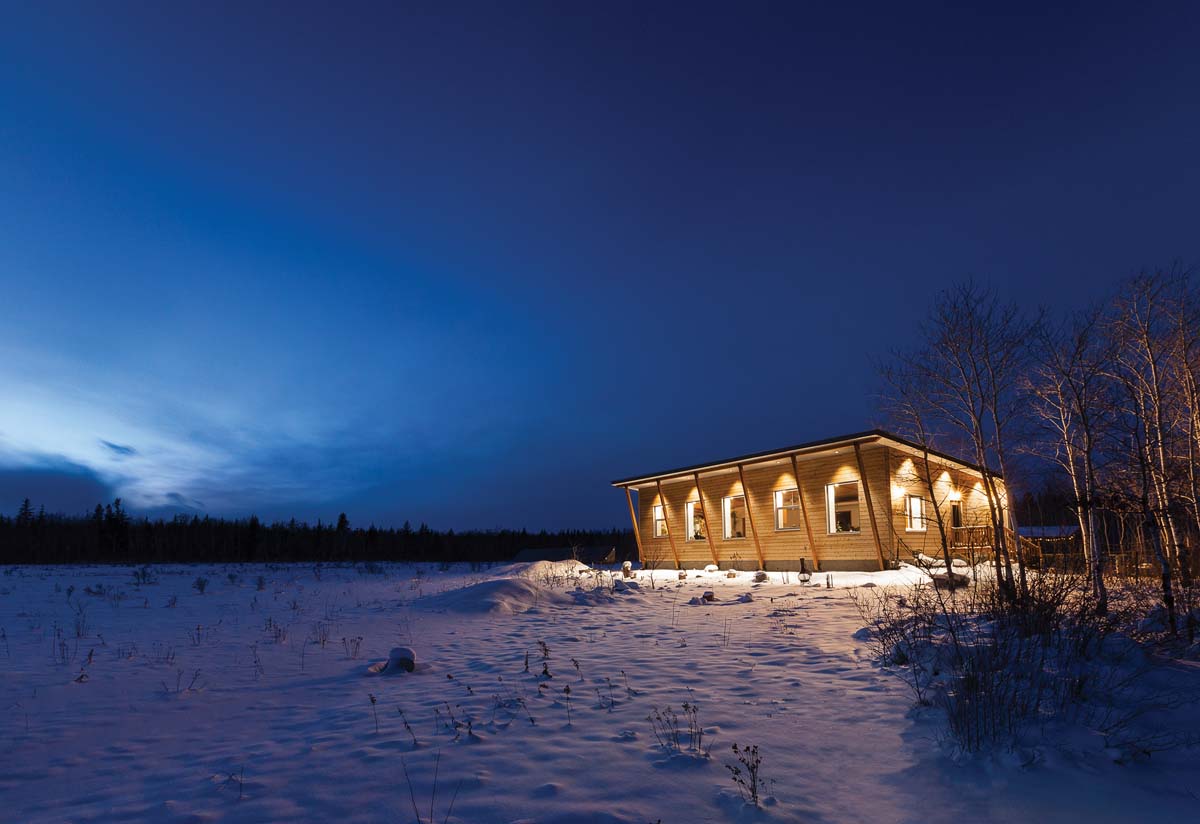
In fact, it would take a few more dancers to heat up a house, but Bridgman’s poetic point is well taken. Built in 2016 near the town of Sandy Hook, Aspen Root was the first building in Manitoba to be designed and constructed on Passive House principles. Bridgman and his highly committed clients imagined the house propagating like the rhizomatic roots of the aspen—a tree ubiquitous in the precolonial Prairie. The building is a rectangle in plan and is oriented, as is typical of sustainable buildings, along an east-west axis. This allows an array of windows along the south façade to harness solar gain and heat the house in the winter. An over-two-metre-deep overhang casts a shadow to manage that heat gain in the summer. But the design is not merely functional. The horizontal gesture of the overhang also references the dual expanses of the Prairie landscape and nearby Lake Winnipeg. The highly figured Tyndall Stone windowsills (with integrated hydronic heating) make use of a material unique to the region. Fibreglass doors and windows, manufactured locally by Duxton Windows & Doors, boast up to four panes of glass (the south windows are triple-pane).
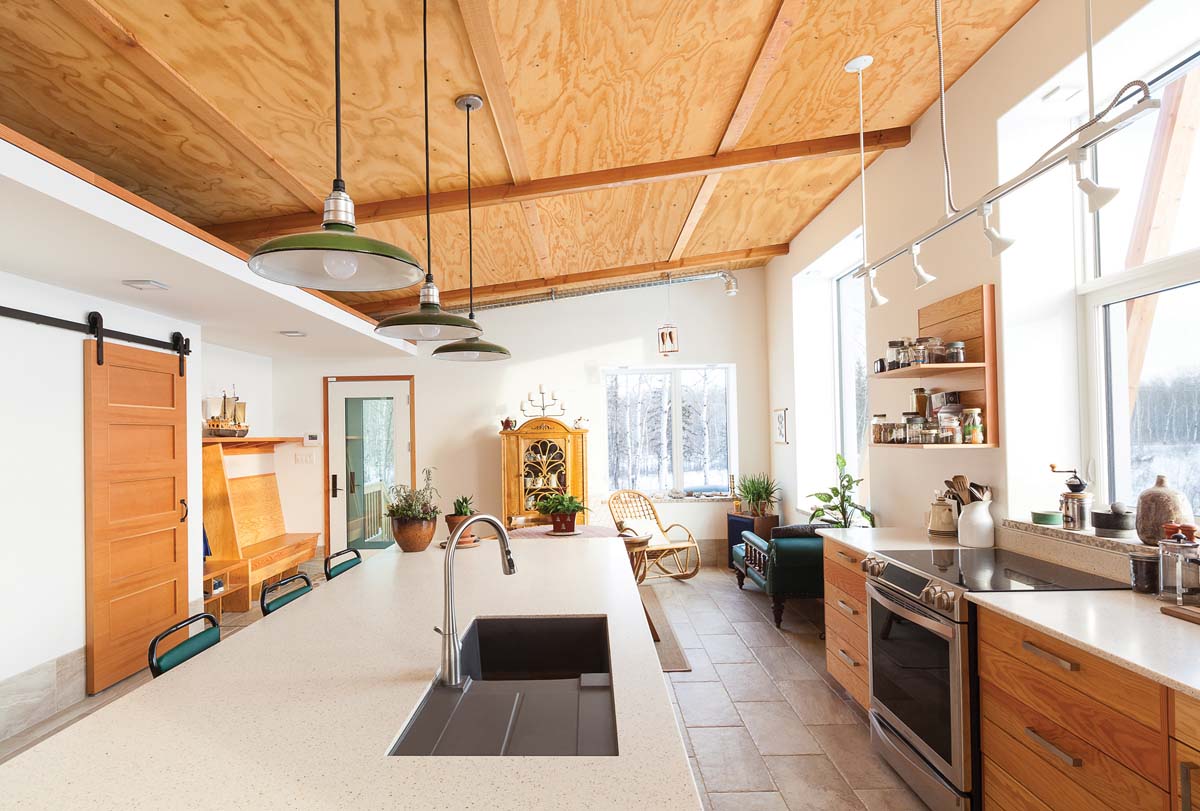
In passive buildings, plywood is often used as a vapour barrier; Aspen Root House makes an aesthetic virtue of that in the exposed Douglas fir plywood ceiling. Taping joints is crucial to the integrity of any vapour barrier: in this case, the tape is cleverly concealed by a grid of battens reminiscent of Japanese saobuchi, lending an air of elegance to the interior. Mineral wool in the metre-deep roof truss, cellulose insulation in half-metre-thick walls and a heat recovery ventilator complete the Passive House strategies. Solar panels have rendered the home net-zero-energy.
The project made extensive use of Passive House’s spreadsheet tool for energy-efficiency planning—the Passive House Planning Package (PHPP)—and included embedded sensors for long-term performance monitoring. But in many respects, it was very low-tech: energy calculations were done laboriously, by hand, through many design iterations. As Bridgman puts it, these were early days for Passive House in Canada, and to get it built the project had to be generated “in the space between hope and fantasy.”
The 100 Year Home
Today, the fantasy is becoming reality as half a dozen passive buildings of increasing scale and complexity break ground in Manitoba. Monteyne Architecture, with sibling firm Bobsled Construction, is responsible for more of these than any other firm. Passive House is the latest area of exploration in a design practice that has long prioritized inventive solutions to minimize energy and carbon use.
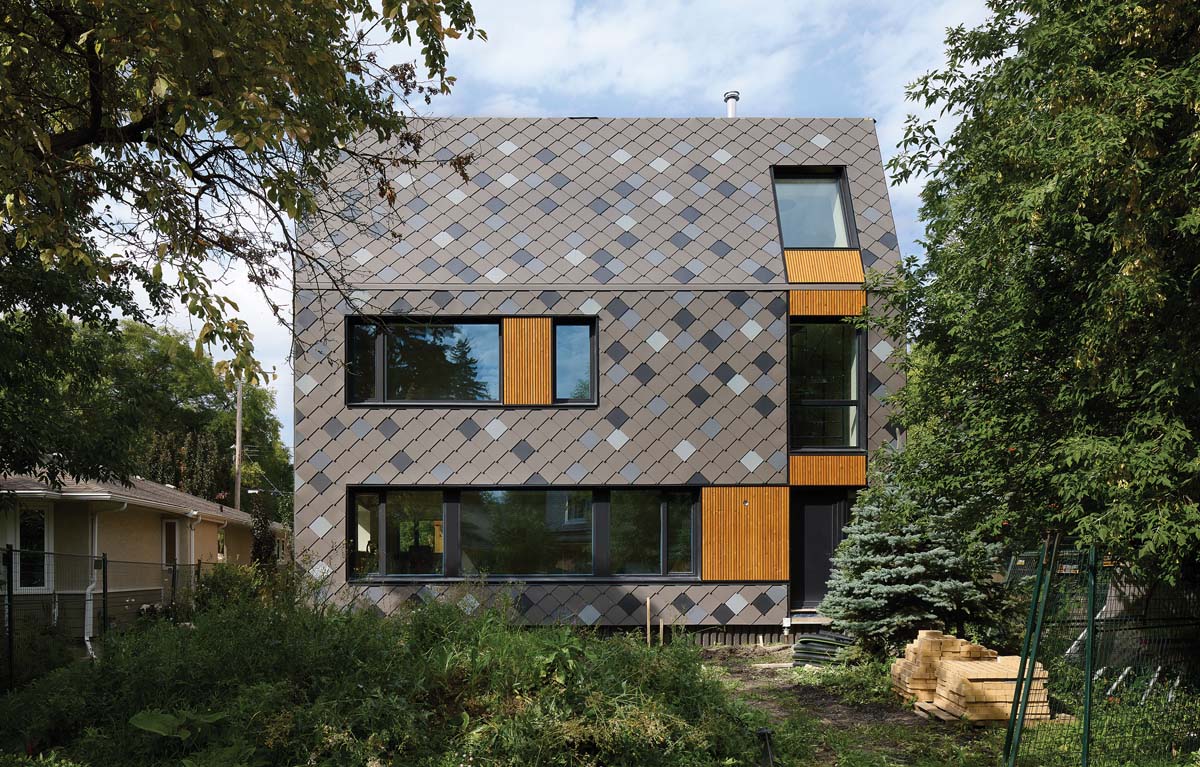
Tom Monteyne’s first Passive House is the 100 Year Home. Its windows face south, toward a public commons, in a Winnipeg neighbourhood laid out on Garden City principles. Like Bridgman’s building, superinsulated walls and many calculations ensure the building’s energy performance. The calculations are done rather more rapidly today, using modelling software integrated into SketchUp plug-ins. The form of the building also differs from the Aspen Root House. It’s not oblong but, consistent with many passive buildings, something approximating a cube. To mitigate Passive House’s tendency toward “boxiness”—a result of minimizing the surface-area-to-volume ratio—Monteyne bevelled the building’s vertical profile. He likens the upper floor to a mansard roof, characteristic of nearby St. Boniface, one of Winnipeg’s francophone quarters. The form also recalls the gambrel roofs of agricultural construction, and mansions in other older neighbourhoods.
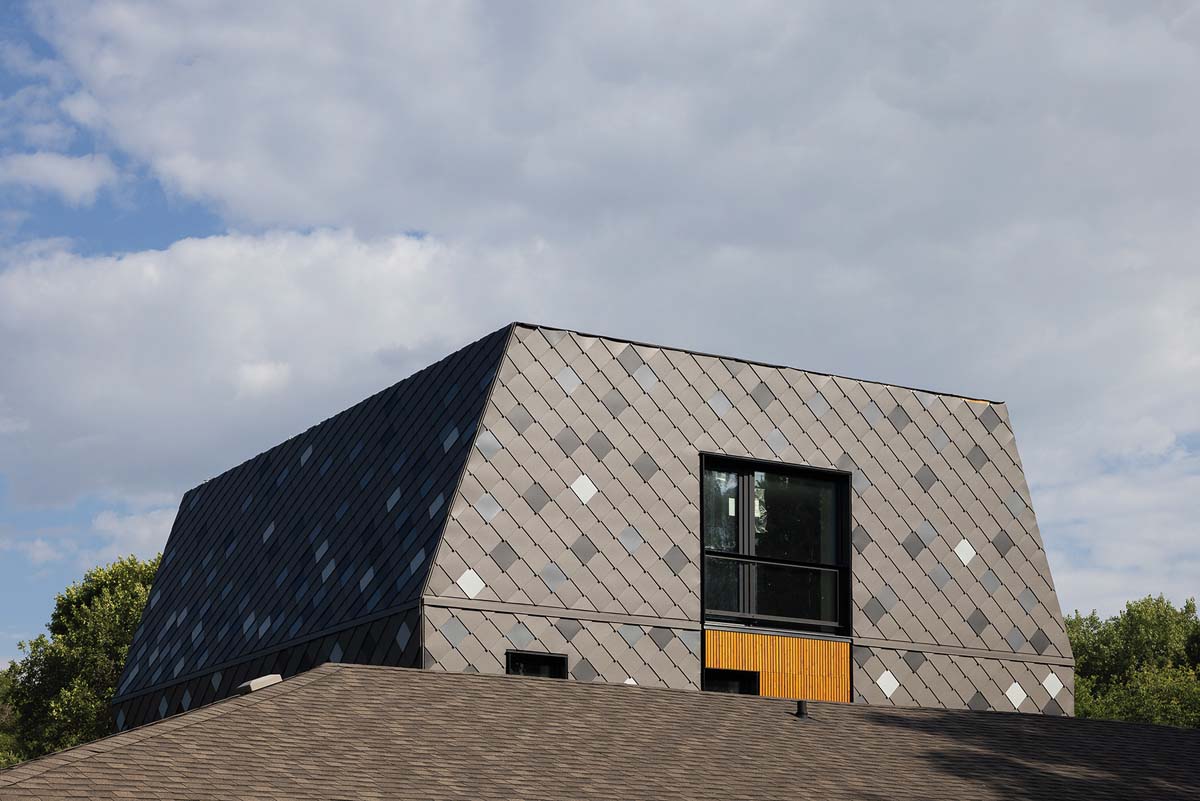
Inside, the plan is organized on a 9-square grid, and the post-and-beam structure supports nail-laminated-timber “mill” floors. The adoption of durable materials extends to steel diamond-tile cladding cascading down from the roof. The tile pattern visually breaks up the large volume of the house. This, together with the mansard roof and preservation of existing trees, allows the large volume to sit beautifully within its site.
Besides leaning toward the box and simple profiles, Passive House can pose other aesthetic challenges for designers. Rigorous orientation to the sun, for example, can challenge the designer’s desire to accommodate other features of the urban environment. In a residence nearing completion in Winnipeg’s Wolseley neighbourhood, Monteyne is accommodating sun, river views and alignment to adjacent roadways by adeptly manipulating the home’s plan while nevertheless keeping it simple and compact.
The rhomboid plan of the Village Canadien Seniors Complex, Monteyne’s design for a seniors’ intentional community, is similarly effective. Organized around a central clerestoried space, it accommodates both social programming and the desire for a sun-lit and sun-warmed gathering area in winter. This project is still in the design stages; at six storeys in mass timber, it represents a step up in scale and ambition from Manitoba’s earlier Passive Houses.
Monteyne’s most ambitious Passive House initiative, dating back a few years, was a proposal for a high-performance visitor centre for FortWhyte Alive, a nature conservancy on the outskirts of Winnipeg. However, while the client bought into the idea, the vicissitudes of architectural practice saw the project go to an open RFP. The project was ultimately won by Stantec Architecture Ltd.
FortWhyte Alive
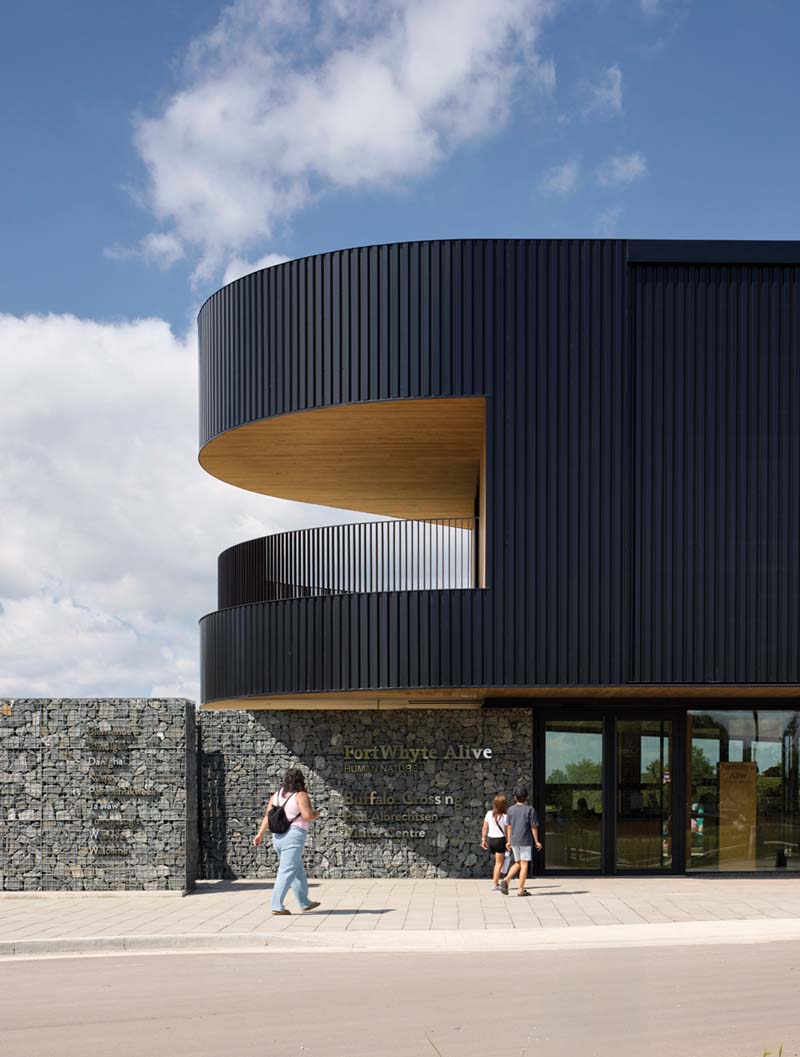
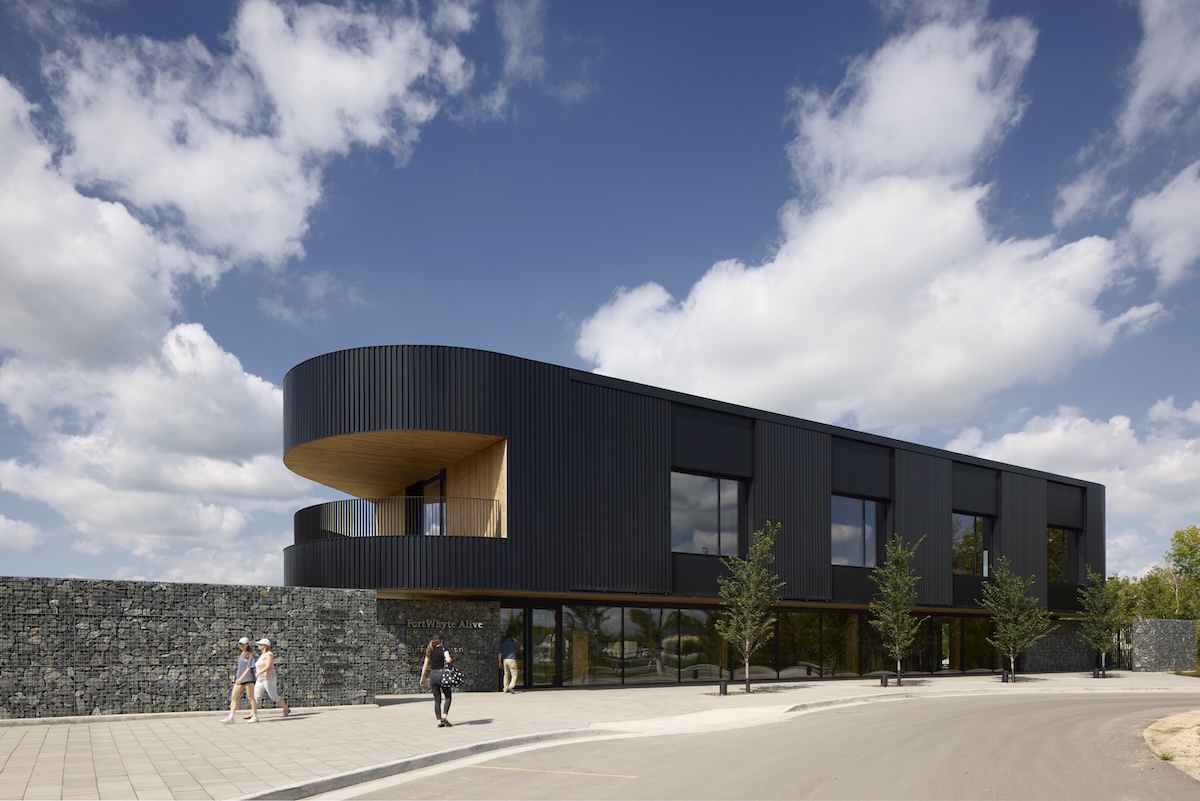
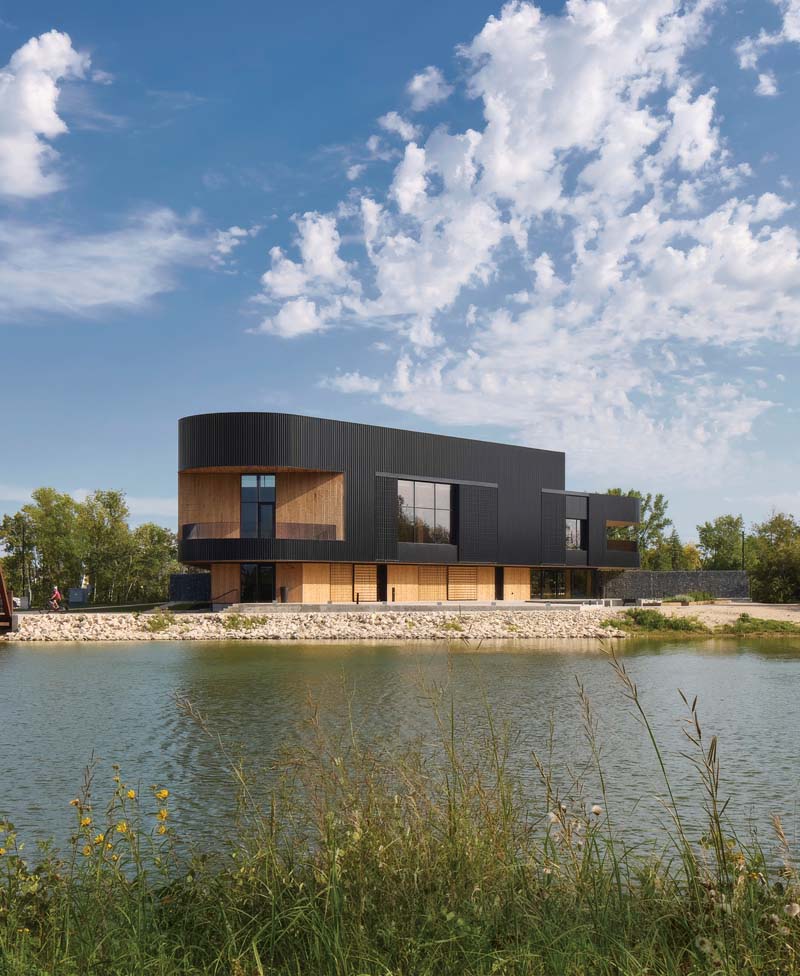
The project provides a south entrance to the FortWhyte Alive nature conservancy, for the first time making the centre accessible by public transit. It accommodates an event-oriented program with views toward Muir Lake, one of several remediated quarries at FortWhyte Alive. This vista, along with orientation toward the sun, was a primary driver of the building’s triangular plan. The grandest views are from the assembly spaces on the building’s second floor. This piano nobile is stacked over the ground floor, and projects beyond it in a clever and satisfying design move that blocks the high summer sun from the glazed ground floor. The large area of glazing enabled by this overhang creates greater transparency through the building at ground level than is normally expected in Passive House buildings, whose envelopes tend toward being massive and opaque. Large expanses of windows on the upper floor also invite solar gain, here managed with perforated metal baffles that can be slid across the windows to suit the season.
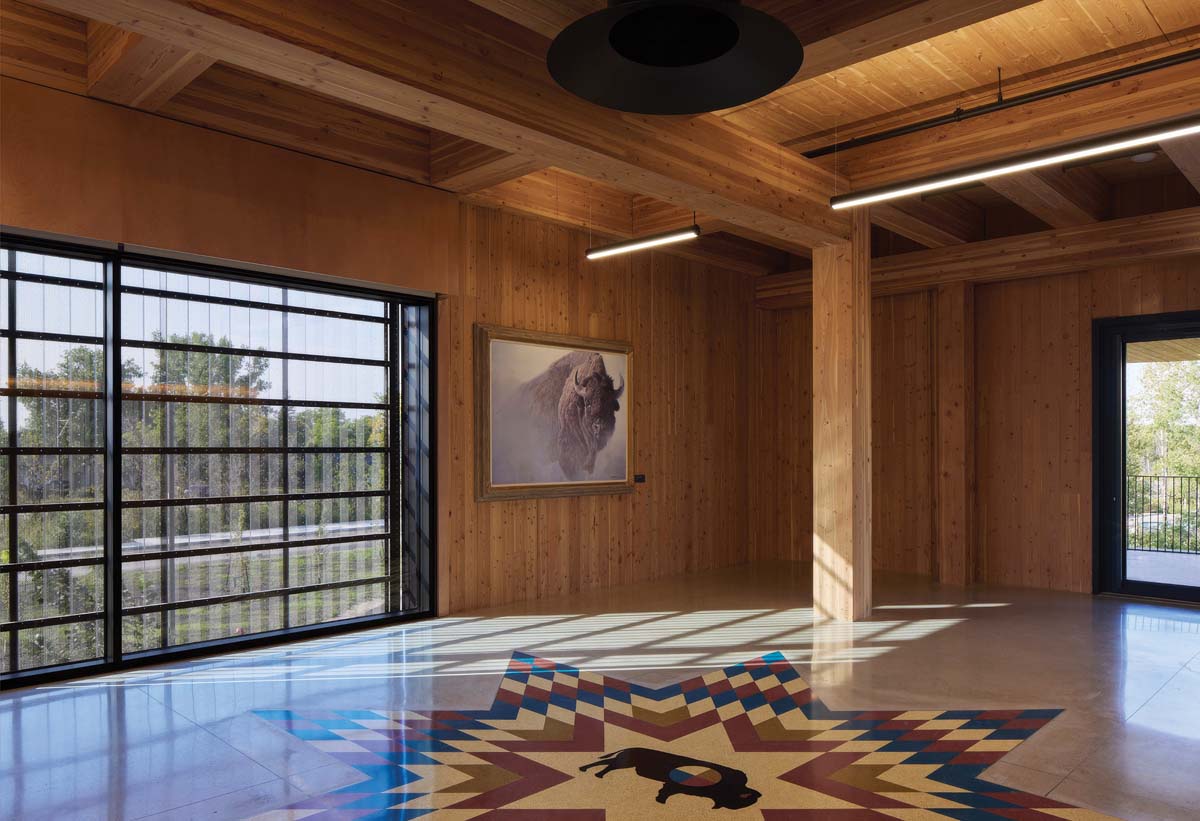
Throughout the project, there is a clear love for the warmth of wood. Exteriors are clad with Thermowood Pine; the interior surfaces are in birch and hemlock veneers stained to complement the Douglas fir mass timber structure. As design architect Michael Banman points out, Douglas fir provides the necessary strength to support the extensive cantilever over the ground floor. Its warmth, strength and imposing structural grid also lend an air of gravitas to the building. Steph Fehr, project architect, says there is one column she wishes could have been vanished from the event space on the second floor—to relax the grid a little and free up the view to the lake. But in fact, the array of massive columns in that double-height space provides an effective and muscular counterpoint to the extruded triangular volume of the room. The simplicity of this volume is emphasized by clear birch veneer millwork. The large windows are thoughtfully framed by perforated metal baffles that provide 30 percent transparency—opaque enough to block sunlight, but transparent enough that, even when fully closed, their veil-like effect accentuates rather than obscures views through to the lake.
In addition to pursing Passive House certification, the FortWhyte Alive Buffalo Crossing Visitor Centre is also targeting Zero-Carbon certification, which requires strategies such as geothermal heating.
The dance of structure, enclosure and prospect, all accentuated by wood, evokes the grand spaces of older landmark buildings in national parks across the continent. In a nice touch, the triangular boardroom table serves as a microcosm of the building—and perhaps of the city, as it is built of elm reclaimed from Winnipeg’s urban forest.
The evolution of Prairie Passive House
If the Aspen Root House could be seen as the beginning of a rhizomatic development of Passive House in this province, it would be natural to ask: What, beyond the goodwill of a few designers and clients, is supporting this evolution?
Manitoba has not always evinced the most progressive attitudes toward sustainable construction. Unlike its progressive development of National Building Code amendments addressing accessibility, at a regulatory level the province has lagged behind others in adopting advanced energy standards. After more than a decade of relying on the outdated 2010 National Building Code (NBC), the 2020 NBC and Energy Code were finally adopted here in 2024. Even then, the province chose to set the standard for energy efficiency at only Tier 1 of the NBC’s five possible levels.
But in other respects, there is a history in Manitoba of political and grassroots support for sustainable design and living. As early as 2007, an earlier government’s Manitoba Green Building Policy mandated that any provincially funded building was to be certified LEED Silver. After a number of political changes, the emphasis is now on targeted programs, including through the provincial agency Efficiency Manitoba, Manitoba Hydro’s Home Energy Efficiency Loans and the provincial government’s Affordable Home Energy Program and Multi-Family Sustainable Housing Infrastructure Program. The shift to broader, performance-based metrics may have cleared a space for Passive House and other alternatives to LEED. Not-for-profit organizations like Sustainable Building Manitoba have helped create a growing local ecosystem supporting sustainable building, by championing Passive House and other pathways to sustainability.
Increasing capacity can be seen in the local building industry too. Duxton Windows & Doors, already mentioned, has been proactive in developing high-efficiency window assemblies, even testing a six-pane prototype. A number of small contractors contributed to sustainable construction goals for many years before the growing market became of interest to larger builders. The most durable of these small firms is Sun Certified Builders, a small-scale contractor dedicated to high-performance residential construction. The firm is run as a workers’ cooperative by cousins Donald and Evan Proven, the second generation of their family to be at the centre of this endeavour. They have served as developers too, taking on high-performance renovations including a Passive House retrofit of a suburban bungalow. Their work can be seen as an application of a specifically Manitoba ethos: drawing on the principled idealism of the Provens’ Mennonite community, global principles of workers’ rights and principles of land stewardship foregrounded by recent steps forward in Indigenous reconciliation.
There is a long history of grassroots progressive politics on the Prairies. It’s a local ethos built in equal parts on pragmatism and idealism—and one that may underlie much of the region’s ongoing embrace of Passive House. People living close to the land understand cycles, and the importance of recycling and minimizing resource use. Accordingly, Prairie architects’ and builders’ recent experiments with Passive House tackle a global problem by pursuing a simple principle with a few straightforward strategies. The results are buildings that are well crafted—and imaginatively deployed in the space “between hope and fantasy.”
Lawrence Bird, MRAIC is an architect, city planner and visual artist based in Winnipeg.
link